
Shower Cubicle Sizes: Complete Guide in MM, Meters, Inches & Feet
Every standard shower cubicle size, from compact 700mm pods to luxury 1200mm walk-ins, with full conversion charts, height tables, and a step-by-step measurement guide. Applicable to Zimbabwe, Philippines, South Africa, UK, India, Singapore, Australia, Pakistan, Ireland, and the United States.
5,000+Installations completed 5.0★Google rating 24-MonthInstallation guarantee ℹ️ Scope of this guideThis article covers shower cubicle and shower enclosure sizes only. For toilet cubicle dimensions, changing room sizing, or disabled-access shower specifications, see our dedicated guides. Those topics are not covered here.
All dimensions are given in millimeters (mm), meters (m), inches, and feet so this guide is useful regardless of which measurement system you work in.
🌍 This guide applies to your countryAll sizes in this guide use metric measurements (mm and meters), which are the standard units for bathroom planning across every country where this guide is read most. Here is how each market aligns:
Philippines: Metric mm and meter dimensions are the standard used by Filipino contractors, architects, and building suppliers. The sizes in this guide apply directly.
South Africa: SANS standards are metric. The sizes in this guide align with South African bathroom specifications.
India: The National Building Code of India (NBC) uses metric. Standard cubicle sizes here match Indian market supply.
Singapore: BCA Singapore specifications are metric. The 900mm × 900mm minimum recommended here aligns with Singapore residential practice.
Pakistan: Metric standard. All sizes in this guide apply directly to Pakistani bathroom planning and supply.
United Kingdom and Ireland: UK and Irish enclosure supply uses these exact mm dimensions. Standard UK sizes (760mm, 800mm, 900mm, 1000mm, 1200mm) are all represented in the master chart below.
Australia: BCA guidelines recommend 900mm × 900mm minimum, which matches the Comfort row in the chart below. AS 1428 accessibility specifications are addressed in the FAQ.
United States: Inches and feet columns are included throughout this guide for US readers working in imperial units.
Choosing the right shower cubicle size is one of those decisions that looks straightforward on paper and gets complicated fast on site. A 900mm square feels spacious in a showroom and cramped once the toilet and vanity are in position. A 1200mm rectangular unit looks luxurious in a catalogue and wrong in a narrow en suite.
This guide is based on over 5,000 shower cubicle installations and draws on real-world fitting experience that specification sheets rarely capture. Whether you are planning a bathroom in Harare, Manila, Johannesburg, London, Mumbai, Singapore, Lahore, Sydney, or anywhere in between, these are the numbers that matter.
Master Shower Cubicle Dimensions Chart
Width and depth are the floor footprint. For glass height, see the dedicated height section below. The inches and feet columns are for US readers and others working in imperial; all other markets use mm and meters.

| Category | Width × Depth (mm) | Width × Depth (m) | Width × Depth (inches) | Width × Depth (feet) | Best For |
|---|---|---|---|---|---|
| Compact Minimum | 700 × 800 mm | 0.70 × 0.80 m | 27.6" × 31.5" | 2.3ft × 2.6ft | Tight en suites, attic conversions, guest bathrooms |
| Standard Most Popular | 800 × 800 mm | 0.80 × 0.80 m | 31.5" × 31.5" | 2.6ft × 2.6ft | Small to medium bathrooms. Fits most layouts |
| Comfort Recommended | 900 × 900 mm | 0.90 × 0.90 m | 35.4" × 35.4" | 2.95ft × 2.95ft | Best balance of space and comfort. Recommended minimum for new builds |
| Spacious | 1000 × 1000 mm | 1.00 × 1.00 m | 39.4" × 39.4" | 3.28ft × 3.28ft | Master bathrooms. Comfortable for two people |
| Rectangular Standard | 1200 × 800 mm | 1.20 × 0.80 m | 47.2" × 31.5" | 3.94ft × 2.6ft | Bathtub replacement. Ideal for walk-in conversions |
| Rectangular Large Luxury | 1200 × 900 mm | 1.20 × 0.90 m | 47.2" × 35.4" | 3.94ft × 2.95ft | Executive bathrooms. Generous elbow room |
| Offset Quadrant | 1000 × 800 mm | 1.00 × 0.80 m | 39.4" × 31.5" | 3.28ft × 2.6ft | Corner installs needing rectangular shape with curved door |
| Walk-In Screen | 1000–1400 mm wide | 1.00–1.40 m wide | 39.4"–55.1" wide | 3.28ft–4.59ft wide | Open wet-room style. Needs 1500mm+ total floor length |
Shower Cubicle Size Comparison: Drawn to Scale
The diagram below shows the floor footprint of five common sizes drawn to scale, with a person outline at approximately 450mm shoulder width for reference.
Standard Shower Cubicle Height
Height is the most overlooked dimension in shower planning and the one that causes the most post-installation regret. Glass that is too short lets steam pour into the bathroom, creates cold draughts at the top, and looks visually cheap regardless of how premium the frame is.
| Category | Height (mm) | Height (m) | Height (inches) | Height (feet) | Notes |
|---|---|---|---|---|---|
| Economy | 1800 mm | 1.80 m | 70.9" | 5.91ft | Adequate for users under 1.7m. Steam escapes easily. |
| Standard Most Common | 1850–1900 mm | 1.85–1.90 m | 72.8"–74.8" | 6.07–6.23ft | Suits most residential bathrooms. Good steam containment. |
| Premium Recommended | 2000 mm | 2.00 m | 78.7" | 6.56ft | Excellent steam retention. Minimum height for pod cubicles. |
| Luxury / Floor-to-Ceiling | 2100–2400 mm | 2.10–2.40 m | 82.7"–94.5" | 6.89–7.87ft | Frameless custom installs. Maximum visual impact. |
Pod showers have a roof cap adding 50–100mm above the glass panel. A 2000mm pod requires at least 2100mm of ceiling clearance, ideally 2200mm to allow installation access. Measure your ceiling before selecting a pod model.
Shower Cubicle Sizes by Shape and Style
1. Square Shower Cubicles
The most versatile shape. Square cubicles fit any 90-degree corner and work with both hinged and sliding door configurations. The 800mm × 800mm is the market default; the 900mm × 900mm is what most experienced fitters recommend when the floor plan allows it, and it nearly always does with a bit of planning.
Browse our range of hinged shower cubicles and sliding shower cubicles for current sizes and pricing.
Minimum 700×800 0.70×0.80m | 2.3×2.6ft Tight spaces only. Pivot or bi-fold door required. Most Installed 800×800 0.80×0.80m | 2.6×2.6ft Industry default. Sliding or hinged doors both work well. ★ Goldilocks 900×900 0.90×0.90m | 2.95×2.95ft Best comfort-to-space ratio. The size most clients wish they had chosen. Spacious 1000×1000 1.00×1.00m | 3.28×3.28ft Luxury feel. Comfortable for two. See our large cubicles.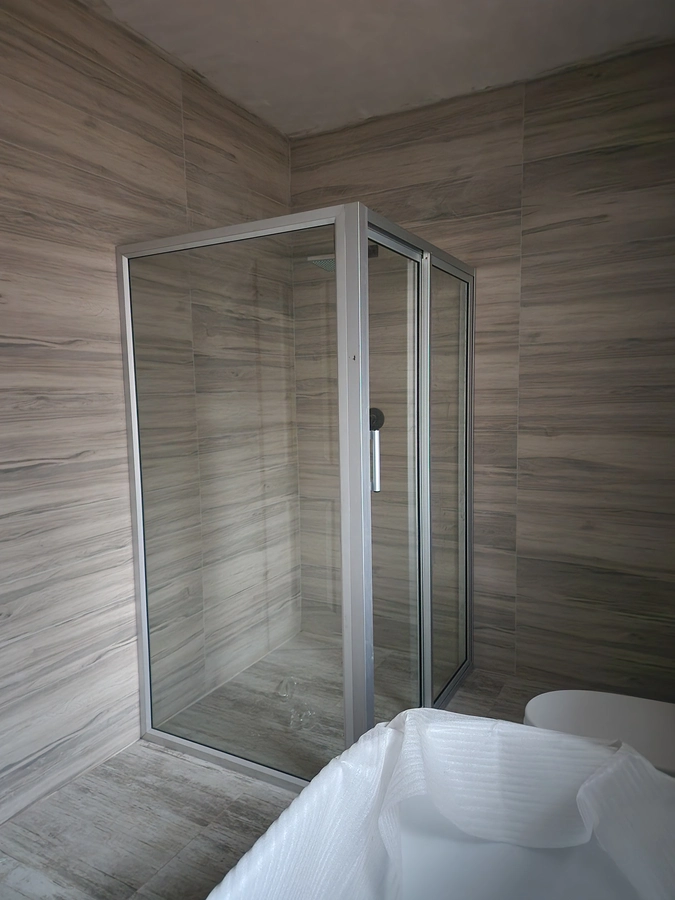
2. Quadrant Shower Cubicles (Space Savers)
Quadrant cubicles have a curved front panel designed for corner installation. Because the door sweeps along a curve rather than swinging out flat, they reclaim floor space in the bathroom. Standard quadrants run at 800mm × 800mm and 900mm × 900mm. Offset quadrants are available in sizes like 1000mm × 800mm, providing more internal showering space without a wide square footprint.
3. Rectangular Enclosures
The standard choice for replacing a bathtub or occupying a dedicated shower alcove. Common sizes start at 1000mm × 800mm and go up to 1700mm × 900mm. The 1200mm × 800mm remains the most widely specified replacement for a standard bath footprint. These units almost always use sliding shower doors; a hinged door on a 1200mm enclosure would require 600mm+ of clear swing space outside the shower, which most bathrooms cannot accommodate.
4. Walk-In Showers
Walk-in showers are defined by an open entry: no door, just a fixed glass screen. Screens are typically 700mm to 1400mm wide. The critical measurement is not the screen width but the total floor run: at least 1500mm from the screen back to the open entry prevents water reaching the bathroom floor. In practice, 1700mm+ is more comfortable.
See our walk-in shower glass range for available panel widths.
5. Three-Sided Shower Enclosures
Three-sided enclosures fit into an alcove with two existing walls and one open face covered by the glass. Sizing follows the same mm and meter conventions as square units. Browse our 3-sided shower cubicles for current stock.
Shower Room Dimensions vs Shower Cubicle Dimensions
A common source of confusion in search results: "shower room dimensions" and "shower cubicle dimensions" are not the same thing.
A shower cubicle (also called a shower enclosure, shower cabin, shower box, or shower booth) is the glass enclosure itself: the unit you buy and install. That is what all the measurements on this page refer to.
A shower room is the total floor area of the bathroom or wet room space that contains the shower. Recommended shower room dimensions depend on what else is in the room, but as a general guide:
| Shower Room Use | Recommended Floor Area (mm) | Recommended Floor Area (m) | Recommended Floor Area (feet) |
|---|---|---|---|
| Shower only (wet room) | 900 × 900 mm minimum | 0.90 × 0.90 m | 2.95 × 2.95ft |
| Shower + WC | 1500 × 1800 mm minimum | 1.50 × 1.80 m | 4.92 × 5.91ft |
| Full en suite (shower + WC + basin) | 1800 × 2400 mm minimum | 1.80 × 2.40 m | 5.91 × 7.87ft |
| Full family bathroom | 2400 × 3000 mm or larger | 2.40 × 3.00 m | 7.87 × 9.84ft |
When planning a shower room, always allocate the cubicle footprint first, then confirm sufficient circulation space (minimum 600mm) around all sides before the walls or door swing.
Minimum Shower Cubicle Size
The smallest functional shower cubicle is 700mm × 800mm (0.70m × 0.80m / 2.3ft × 2.6ft / 27.6" × 31.5"). This is a floor, not a recommendation. At this size, usable internal space after door frame and wall profiles is approximately 620mm × 720mm, enough to stand, turn, and wash without touching all four surfaces at once, but not comfortably.
Most building standards globally treat 900mm × 900mm as the practical minimum for comfortable use. In South Africa, SANS 10400-S specifies a minimum shower floor area of 900mm × 900mm for new residential construction. Australian BCA sets the same. The UK Building Regulations Approved Document M recommends 1500mm × 900mm for accessible shower designs.
⚠️ Do not use sliding doors on a 700mm cubicleA sliding door panel overlaps itself when open, reducing the actual entry gap to roughly 300–320mm on a 700mm unit. That is uncomfortably narrow for most adults. Use a pivot or hinged shower door at 700mm widths.
How to Measure Your Space for a Shower Cubicle
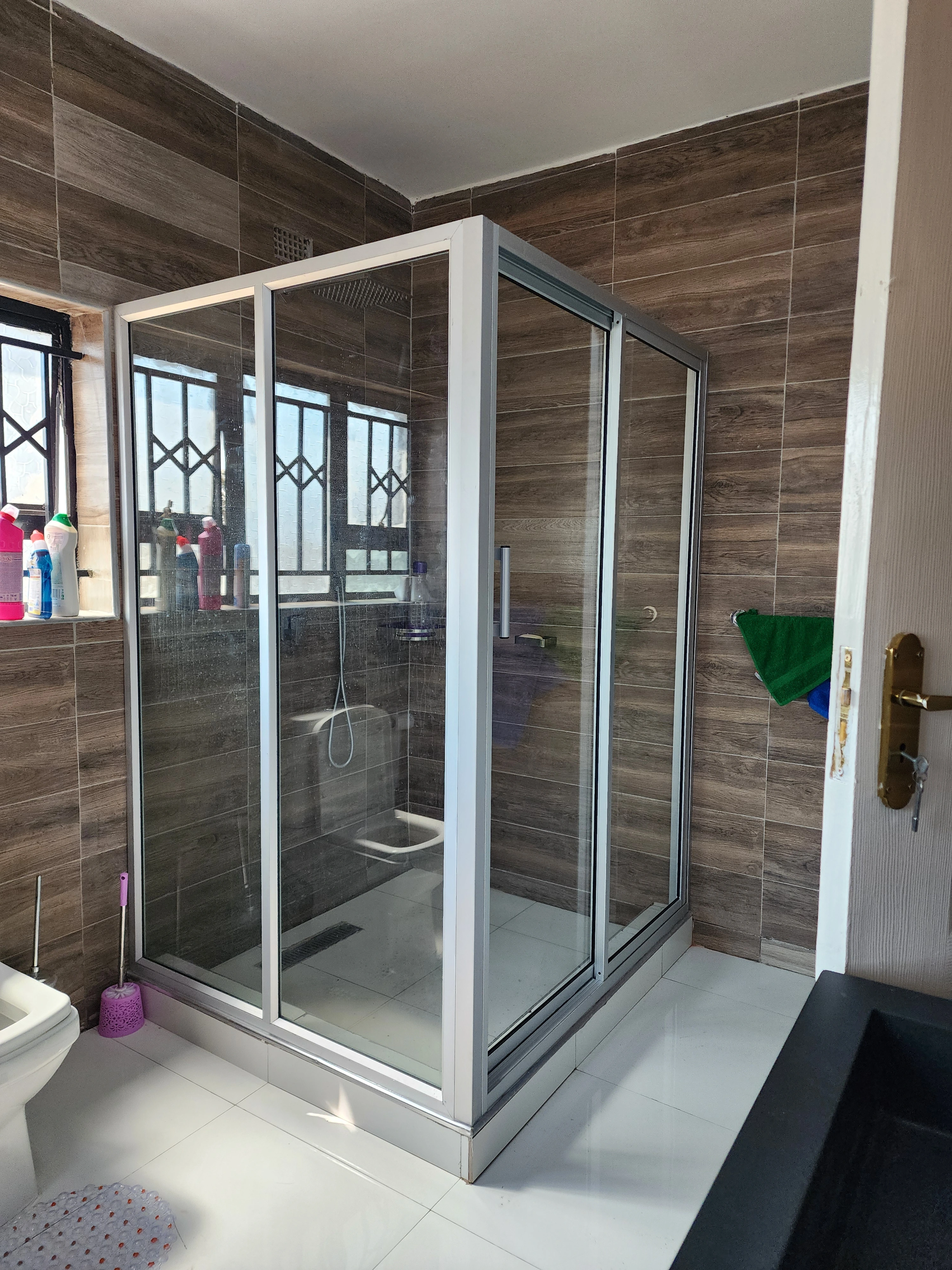
Do not rely on a single measurement taken at eye level. Walls in older homes (and many newer ones) bow, lean, and taper. A cubicle bought to fit one measurement at waist height will often not close properly at floor level or bind against the wall at the top.
Door Styles, Clearance & Space Efficiency
The door style you choose is inseparable from the cubicle size. A hinged door on a compact bathroom plan, or a sliding door on a too-narrow unit, creates daily frustration that no amount of good tiling will fix.
| Door Style | External Clearance | Min. Cubicle Width | Best Suited For |
|---|---|---|---|
| Hinged (Outward) | 600mm / 2.0ft minimum | 700mm / 2.3ft | Large bathrooms, toilet/vanity well clear |
| Sliding (Single) | None | 800mm / 2.6ft | Rectangular enclosures, medium bathrooms |
| Sliding (Double) | None | 900mm / 2.95ft | Square corner enclosures, tight bathrooms |
| Bi-Fold | 150–200mm / 0.5–0.66ft | 700mm / 2.3ft | Compact spaces, attic conversions |
| Pivot | 200–250mm / 0.66–0.82ft | 700mm / 2.3ft | Small cubicles where bi-fold isn't available |
When Standard Sizes Won't Work
Standard sizes cover most bathrooms. The remainder have sloping ceilings, alcoves that taper, structural columns intruding on the shower zone, or existing tiling in an irregular shape. Forcing a standard-size unit into a non-standard space produces a result that looks improvised regardless of how well it is installed.
Shower Cubicles Zimbabwe manufactures custom shower enclosures cut to exact dimensions. Glass panels are cut to specification, frame profiles are cut on site, and the result fills the space precisely. The free on-site measurement service is available across Zimbabwe, including Harare and surrounding areas, specifically to catch non-standard situations before any glass is cut.
📐 Free on-site measurement, no commitment requiredOur team measures your space, identifies any issues (bowed walls, obstructions, drainage positions) and advises on the best size and configuration before you commit. Delivery and installation within 2 working days of agreement, anywhere in Zimbabwe. Call or WhatsApp +263 772 420 021.
Browse by cubicle category:
Sliding Shower Cubicles Hinged Shower Cubicles Large Shower Cubicles Walk-In Shower Glass 3-Sided Shower Cubicles Sliding Shower Doors Hinged Shower DoorsGet the Right Size, First Time
5,000+ installations across Zimbabwe. Free on-site measurement. 24-month installation guarantee. Countrywide delivery within 2 working days.
Get a Free Quote Contact Our TeamQuick-Reference Size Summary
- 700mm (0.70m / 2.3ft): Absolute minimum. Tight spaces only. Use pivot or bi-fold door. Not recommended for a primary bathroom.
- 800mm (0.80m / 2.6ft): Industry standard for small to medium homes. Widely available. Sliding or hinged doors both work.
- 900mm (0.90m / 2.95ft): The size most clients wish they had chosen. Best comfort-to-footprint ratio. Our most recommended size.
- 1000mm+ (1.00m+ / 3.28ft+): Luxury territory. Ideal for master bathrooms, walk-in conversions, and anyone who wants genuine freedom of movement.
- Height: 2000mm (2.00m / 6.56ft): Choose 2000mm glass height wherever ceiling clearance allows. The difference from 1900mm is visible and worth it.
Frequently Asked Questions
What is the standard size of a shower cubicle?
The most widely installed standard shower cubicle size is 800mm × 800mm (0.80m × 0.80m / 31.5" × 31.5" / 2.6ft × 2.6ft). For rectangular enclosures, 1200mm × 800mm is the industry standard. The 900mm × 900mm is increasingly considered the practical standard for new builds, providing noticeably better comfort. Standard glass height is 1850mm to 1900mm in most configurations.
What is the standard shower size in meters?
The standard shower size in meters is 0.80m × 0.80m for square enclosures and 1.20m × 0.80m for rectangular ones. For comfort, 0.90m × 0.90m is what most experienced fitters now recommend as a practical minimum. Walk-in showers require a total floor run of at least 1.50m to prevent water from escaping the enclosure zone.
What is the minimum size for a shower cubicle?
The absolute minimum functional shower cubicle size is 700mm × 800mm (0.70m × 0.80m / 27.6" × 31.5" / 2.3ft × 2.6ft). At this size, usable internal space after door frame and profiles is approximately 620mm × 720mm. Most building standards globally, including South African SANS, UK Building Regulations, and Australian BCA, treat 900mm × 900mm as the practical comfort minimum.
What is the standard shower cubicle height?
Standard shower cubicle glass height is 1850mm to 1900mm (1.85m–1.90m / 72.8"–74.8" / 6.07ft–6.23ft). Premium installations use 2000mm panels (2.0m / 78.7" / 6.56ft). For pod cubicles with a sealed roof, ensure ceiling height is at least 2100mm before selecting a 2000mm pod, to allow for the roof cap and installation clearance.
What is the smallest shower cubicle size available?
The smallest standard shower cubicle size is 700mm × 700mm in some manufacturers' ranges, though 700mm × 800mm is far more common at the compact end. Below 700mm width, the entry gap with a door fitted becomes impractical for most adults. For genuinely tight spaces, a custom-built unit is usually a better result than forcing a standard product into an undersized opening.
What is the average size of a shower cubicle?
The average shower cubicle size installed in homes globally is 800mm × 800mm (0.80m × 0.80m / 2.6ft × 2.6ft). That average is shifting toward 900mm × 900mm in new builds as homeowners prioritise comfort over saving a few centimetres of floor space. For rectangular enclosures, the average is 1200mm × 800mm (1.20m × 0.80m / 3.94ft × 2.6ft).
What size shower enclosure do I need?
Measure your available floor space at three heights: floor level, mid-height (around 1 metre), and at the top of where the glass will reach. Use the smallest of those three measurements for both width and depth. Subtract approximately 20mm per side for wall profiles. If the result is 900mm or more in both directions, a 900mm cubicle is the recommended choice. For tighter spaces, 800mm is the practical standard. A free on-site measurement removes all guesswork. Contact us before ordering if there is any uncertainty.
What are standard shower cubicle dimensions in mm?
Standard shower cubicle dimensions in mm: compact 700×800mm, standard 800×800mm, comfort 900×900mm, spacious 1000×1000mm, rectangular standard 1200×800mm, rectangular large 1200×900mm. Standard glass height across all these sizes is 1850mm to 1900mm. The full chart with meter, inch and feet conversions is in the master table near the top of this guide.
How do I measure for a replacement shower cubicle?
Measure the opening width at three heights: floor level, at approximately 1 metre high, and at the top of where the glass will sit. Use the smallest of the three figures. Repeat for depth. Measure from tiled wall to tiled wall at each point. Do not measure only the existing glass panel. Frame profiles on a new cubicle typically adjust for up to 15–20mm of variance between measurement points.
What size is a walk-in shower?
A walk-in shower glass screen is typically 1000mm to 1200mm wide (39.4"–47.2" / 3.28ft–3.94ft), though screens are available from 700mm to 1400mm. The screen width alone does not determine usability: you need a total floor run of at least 1500mm (1.5m / 4.92ft) from the screen back to the open entry to prevent water reaching the main bathroom floor. 1700mm of total floor length is more comfortable for daily use.
What is the standard shower cubicle size in Australia?
Australian Building Code (BCA) guidelines recommend a minimum shower area of 900mm × 900mm (0.90m × 0.90m / 2.95ft × 2.95ft) for residential use. This matches the Comfort size in the master chart above. Accessible showers under AS 1428 specify a minimum of 1160mm × 1160mm with turning space, which is a separate specification for disability access and not the residential standard. All metric dimensions in this guide apply directly to Australian bathroom planning.
Can shower cubicles be made to a custom size?
Yes. Shower Cubicles Zimbabwe manufactures custom shower enclosures to exact dimensions. If your space has sloping ceilings, irregular alcoves, structural obstructions, or existing tiling that does not match a standard size, a custom unit produces a far better result. Our free on-site measurement service identifies your exact requirements. Delivery and installation are completed within 2 working days of agreement, anywhere in Zimbabwe.
Contact the Shower Cubicles Zimbabwe team on +263 772 420 021 or request a free quote online. Free on-site measurements available across Zimbabwe. All installations guaranteed for 24 months.